
2026 Summer Plant Stewardship Volunteer positions are now open!
2026 activity dates:
April 2026
-
-
- 25 (Saturday) Earth Day
-
May 2026
-
-
- 15 (Fri) SLCPU Quail Hollow
- 21 (Thursday) Evening
- 23 (Saturday)
- 28 (Thursday) SLCA
- 30 (Saturday) SLCA
-
June 2026
-
-
- 4 (Thursday)
- 6 (Saturday) National Trails Day
- 11 (Thursday)
- 13 (Saturday)
- 18 (Thursday)
- 20 (Saturday)
- 25 (Thursday) Evening
- 27 (Saturday)
-
July 2026
-
-
- 9 (Thursday)
- 16 (Thursday)
- 23 (Thursday) Evening
- 30 (Thursday)
-
August 2026
-
-
- 1 (Saturday)
- 6 (Thursday)
- 8 (Saturday)
- 13 (Thursday)
- 15 (Saturday)
- 20 (Thursday)
- 22 (Saturday) Trails Utah
- 27 (Thursday)
- 29 (Saturday)
-
September 2026
-
-
- 3 (Thursday)
- 5 (Saturday)
- 10 (Thursday) Evening
- 12 (Saturday)
- 17 (Thursday)
- 19 (Saturday)
- 24 (Thursday)
- 26 (Saturday) National Public Lands Day
-
Invasive weed management
 An invasive weed is a plant that has been introduced by humans to a given ecosystem and is causing environmental, economic, or human harm. Invasive weeds tend to spread aggressively and rapidly by producing many seeds or spreading by underground structures such as rhizomes. Because they are not native to this area, they have no natural predators and can reproduce out of control. Invasive weeds are often the first plants to become established in areas of human disturbance such as new trails, ski runs, or picnic areas. If unchecked, they can out-compete native species like many of our world-renowned native wildflowers. Invasive species can also increase the risk of catastrophic wildfires, release toxic chemicals into the soil, and reduce our ecosystem’s resilience to disease, pests, and climate change.
 The CCF Plants Crew scouts every official trail, campground, picnic area, and ski area in BCC, LCC, and Millcreek Canyon and prioritizes mitigation measures based on species, location, and impact. Using a combination of mechanical control (hand pulling, weed wacking, and mowing) and chemical control (using watershed approved herbicides that have proven effective on each species), invasive species are systematically eradicated or managed. All weed populations are carefully mapped using the ArcGIS Collector App and ArcGIS Pro is used for tracking, planning, and analysis of disturbances, invasive populations, and restoration throughout the canyons.
Our beloved Tri-Canyon area provides us with countless benefits such as clean drinking water, the best snow on earth, and wildflowers, just to name a few. It is our responsibility as stewards of these canyons to act with reciprocity for these open spaces so they will be healthy for years to come.
How can you help?
- If you live in or near the Tri-Canyons, remove invasive plants from your property so seeds are not getting dispersed into open spaces. If you want help identifying the weeds on your property or learning about how to treat them, contact the Plant Stewardship Director.
- Recreators are sometimes unknowingly spreading invasive plant seeds. Check your socks and your dog for burrs and throw them in the trash (do not release them into the environment) after each hike!
- If you create a disturbance on your property (churn soil, construction, etc.), commit to removing invasive species that colonize those areas.
- If you think you found a Class I or Class II species while you are out recreating in the Tri-Canyons, we want to know about it! Please contact the Plant Stewardship Director via the button at the bottom of this page.
Restoration
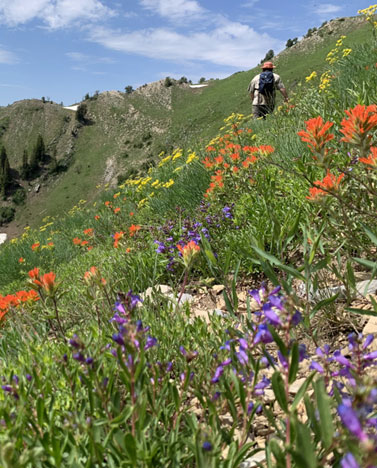
 As invasive weeds are removed from the environment, revegetation is an equally important step in the process. Invasive weeds prefer disturbed soil, which means they can easily reestablish in the areas where they are removed. Instead, the CCF Plants Crew plants hundreds of native wildflowers each season to reestablish biodiversity and native species populations. These native wildflowers are grown locally over the winter months by our partner, Dryland Horticulture, from seeds that are hand-collected from roughly the same location and elevation that they are planted the following summer.
In 2024, CCF began a new scientific study to track the survival of restoration plants in the Tri-canyons. The goal of this project is to understand what factors within our control lead to the highest rates of survival and success for our restoration plants. With several years’ data, this study is now providing results that are shaping restoration projects across the Wasatch Front.